

Working To Keep You Informed About What They Don't Want You To Know
The Barancik Foundation's Million-Dollar Influence Network: Media, Public Money, Political Venues, and an Apparent Shared Agenda

In September 2022, the Charles & MargeryBarancik Foundation - a Sarasota philanthropic institution with a board, a budget, and presumably no appetite for becoming anyone's scandal - gave nearly
$600,000 to WUSF Public Media, the NPR affiliate licensed to the University of South Florida.
The foundation did not hide it. Quite the opposite. Its announcement declared that the money would launch the Community News Collaborative, paying for an editor and four multimedia reporters whose work would be distributed to more than a dozen Gulf Coast news outlets.
Not very cloak-and-dagger. They even issued a press release.
In July 2023, the foundation gave WUSF another $598,750 for the same project. Its public database called the grant the "CMBF Initiative: Community News Collaborative" and described its purpose as creating "a more informed citizenry through quality news coverage of local stories."
That brings the total to nearly $1.2 million,with WUSF named as the recipient both times.
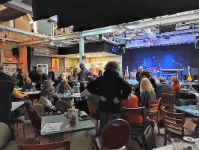
Forgartyville - The Sarasota Democrat Progressive venue
From 2022 through 2024, WSLR - the non profit operating Fogartyville in Sarasota's Rosemary District - participated in the Collaborative. It was not the payee or the grantee. It was one of more than a dozen outlets distributing the journalism.
WSLR announced its participation itself, cheerfully and repeatedly, in annual reports sitting on its own website. Nobody needed a subpoena, a trench coat, or a parking-garage informant. They were proud of it.
Then came the inevitable nonprofit costume change.
In 2025, the Collaborative ended and reappeared as Suncoast Searchlight: more investigative, less collaborative, and backed by $1 million from the same Barancik Foundation.
There is also Gulf Coast Community Foundation money and it is also documented. Gulf Coast awarded Suncoast Searchlight a $12,500 grant to continue the Searchlight Series, through its Nancy Jo Marchisello Charitable Fund. That's a specific, citable figure
The arrangement is not difficult to understand. Two foundations finances a newsroom. A community radio station distributes some of its work. The newsroom is later reborn under a new name and continues operating.
There is no cheque from Barancik to WSLR in this chain. There is no smoking gun. There is a funding and distribution network with several names attached to it, all visible in public documents.
Apparently, paperwork is less exciting than paranoia.
WSLR is Not Operating on a Shoestring
WSLR's role should not be exaggerated. Its federal filings do not separately report income from the Community News Collaborative, and the documented Barancik Foundation grants went to WUSF, not WSLR.
But WSLR should not be portrayed as a penniless community radio station surviving on loose change, donated microphones, and volunteer optimism either.
WSLR Inc. - EIN 56-2485148 - reported steadily increasing revenue in its federal filings. Across three fiscal years (2023/2024/2025), WSLR reported $2,056,821 in total revenue, including $1,075,214 in contributions and grants.
Its annual revenue increased by approximately 49 percent between FY2023 and FY2025, rising from $541,375 to $807,388.
By FY 2025, WSLR reported $420,789 in program-service revenue alone. That is not a media empire, but neither is it a shoestring operation whispering into a borrowed microphone from the back of someone's garage.
Then the Loop Closes
This is where the story moves beyond a foundation doing perfectly ordinary foundation things.
Baquet
On November 19, 2026, Suncoast Searchlight hosted an event featuring Dand Baquet who most recently held the title of Executive Director of the New York Times, a role he served from May 2014 to June 2022. The event is held at Harvest Hall venue called the Graham, located at 3650 17th Street in Sarasota.
Baquet has spent years publicly criticising Donald Trump's truthfulness and calling his attacks on the press "out of control." The moderator was Emily Le Coz, Suncoast Searchlight's executive editor-in-chief.
In 2016, Baquet said Trump "lies about small stuff," contradicts himself and insists that demonstrably false claims are true. (The New York Times).
In 2018, he called Trump's attacks on the press "out of control" and said they were damaging the country's civic life and public debate. (The Guardian).
At the November 2026 Sarasota event, Baquet described "the constant pounding and attacks on the press by the president" as part of a cumulative threat he considered "scary." (Suncoat Searchlight)
In a 2026 interview, he said Trump "lies openly without stopping"and tries to undermine the press's credibility.
Harvest Hall has also hosted a series of other political, cultural, and advocacy events.
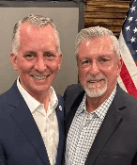
Jolly and Edwards
On October 3, 2026, the hall hosted Democrat SarasotaCounty School Board member Tom Edwards for a Public-School Renaissance Rally
with David Jolly, the Democratic nominee for governor of Florida.
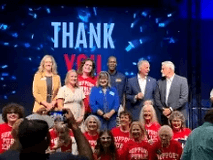
Also appearing were Democrat School Board members Liz Barker, Beth Mayberry, and Megan Tennimon, along with Jimmy Glover, a Democratic candidate for the School Board.

Chairman Edwards and newly installed Sarasta County School Board
Six weeks later, on November 18, the School Board reorganized and named Edwards chair and Barker vice chair, the same sitting members who had appeared on the Harvest Hall stage on 10/3/2026. Perhaps the seating chart was merely prophetic.
On October 10, Harvest Hall hosted the fourth annual Diverse Fest, organized by the church and featuring LGBTQ+ and BIPOCvendors and performers. The venue was also connected with the Gulf Coast Pride
Festival and its volunteers.
On November 17, it hosted a School Board invocation featuring the Pastor Dan Minor speaking about banned books and belonging. Two days later came the Suncoast Searchlight fund raiser featuring Dean Baquet.
So the room's ledger reads:
A partisan rally, a School Board invocation, a progressive church's community festival, and a media fundraiser headlined by one of the most prominent anti-Trump editors in American journalism. All in a building owned by a homeless-services nonprofit that receives public money.
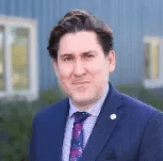
Dan Minor
Here is the actual story, and it is not the one people keep getting wrong. The Graham is not a public venue in the ordinary sense. It is a private asset of Harvest Tabernacle of Sarasota, Inc., whose CEO, pastor, and corporate registered agent Dan Minor is the same man, and whose board chair shares his surname.
It rents itself out as an "affordable" nonprofit venue — $450 an hour for nonprofits, $500 for private events — andits own leadership has said the income funds the mission. Minor put it plainly: "Most of the nonprofits can afford it. It's a great space. We make income off of it."
That is not a scandal. That is a business. The question is what the business is being used to accomplish.
A venue cannot be simultaneously a subsidised charitable asset, a church hall, a partisan rally site, a taxpayer-supported gathering space, and the promotional machinery of a funder's media strategy — and then plead neutrality when someone notices the guest list.
None of this requires a conspiracy. Conspiracies are things people deny. Every booking here was posted publicly, every grant was announced with pride, and every participant would confirm their attendance without hesitation.
It is, in the end, an address book. The same few institutions north of the causeway, rotating through the same rooms, funding each other's events, hiring each other's former executives, and placing each other's names on the same stages — while calling it community engagement and invoicing it as nonprofit work.
The Graham is not a public venue. It is a private asset of Harvest Tabernacle of Sarasota, Inc., whose CEO, pastor, and corporate registered agent Dan Minor is the same man, and whose board chair shares his surname. It rents itself out as an "affordable" nonprofit venue — $450 an hour for nonprofits, $500 for private events — and its own leadership has said the income funds the mission. Minor put it plainly: "Most of the nonprofits can afford it. It's a great space. We make income off of it."
The question is what the business is being used to accomplish. A venue cannot be simultaneously a subsidised charitable asset, a church hall, a venue for partisan political activity.
The Building Is Only the Front Door
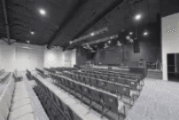
Harvest Hall a.k.a The Graham where these various events take place is not an isolated rental venue floating in civic space. It sits at the headquarters of Harvest House, whose legal entity is Harvest Tabernacle of Sarasota, Inc.
That legal name matters because it is the name appearing in government contracts, property records, grant documents, and public databases. "Harvest House" may be the friendly name on the brochure, but Harvest Tabernacle is the entity holding the deeds.
Sarasota County's 2026 property recordsidentify 45 parcels owned under that name. Their combined official just, or market, value is $16,245,900.
Not one hall. Not one modest church property. Forty-five parcels with an assessed market value of more than $16.2 million.
That number does not mean Harvest House has $16.2 million sitting in a checking account. Some properties serve housing programs, some may carry affordability restrictions, and an assessed value is not the same thing as immediately available equity. But it does establish scale
- rather more scale than the image of a small nonprofit venue passing a
collection plate might suggest.
And then there is the public money.
The documented record shows at least$4,521,912.43 in public funding already paid, obligated, or awarded to Harvest House or its legal entity for housing, shelter, recovery, veterans' services, case management, property acquisition, and related programs.
A further $3,415,500 appears in approved orcontracted public funding not yet shown as paid.
That produces a documented public-fundingfootprint of at least: $7,937,412.43.
The actual historical total is likely higher because not every older local contract and program payment appears in a complete, searchable, year-by-year record.
There is no need to inflate the figure. Nearly $7.94 million in documented public commitments and a $16.25 million real-estate portfolio are quite capable of standing upright without creative accounting.
So the board now looks like this:
Barancik Foundation finances the newsroom.
Harvest Hall supplies the venue.
In November 2023, the Barancik Foundation gave Harvest House $600,000 and described it as "a longtime collaborator with
Barancik Foundation and key partner affordable housing and
criminal-justice recidivism initiatives."The same small circle of institutions and people appears across grant lists, advisory boards, stages, and event calendars.
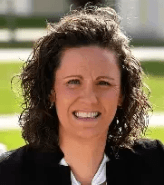
Then there is Erin Minor.
Minor ran Harvest House for twenty-two years, left in 2025 to become a vice president at the Gulf Coast Community Foundation.
Every link is documented. Every link is public. Every link, examined by itself, is perfectly ordinary. Together, they form something far less theatrical than a conspiracy and far more useful: an address book.
Do not call it a conspiracy. Conspiracies are things people deny. This is a network whose participants would probably confirm every entry before asking whether the donor acknowledgment should appear in twelve-point or fourteen-point type.
The Sharper Public Question
WSLR's own annual report says it received funding from the State of Florida and Sarasota County to support music and arts programming at Fogartyville.
On its face, that is ordinary. A 501(c)(3) arts venue receiving public arts funding is not inherently scandalous. Pretending otherwise would be foolish.
The same principle applies to Harvest House. A nonprofit receiving public money to provide affordable housing, emergency shelter, addiction recovery, food assistance, or services for veterans is not
evidence of wrongdoing. Those are legitimate public purposes, and government frequently contracts with nonprofits to deliver them. But public support changes the nature of the question.
When an organization controls 45 parcels valued at more than $16 million, operates a venue used for candidate events and political advocacy, and has a documented public-funding footprint approaching $8 million, taxpayers are entitled to ask where the subsidized programs end and the political venue begins.
Which public funds support housing and recovery services? Which support property acquisition, renovation, staffing, utilities, security, maintenance, or shared overhead? Does Harvest Hall operate independently from publicly funded programs, or do those programs indirectly
absorb costs that make the venue possible? What safeguards separate charitable and governmental work from candidate events and partisan political activity?
Those are accounting and governance questions, not accusations.
The same is true at Fogartyville. If a publicly supported arts venue also hosts candidate events, get-out-the-vote drives involving party personnel, and political organizing, taxpayers are entitled to ask exactly what their money subsidizes and how the costs are separated.
This is the argument.
It does not require a cheque that never existed. It does not require treating private foundation grants as taxpayer money. It does not require pretending that every person appearing at the same venue is part of a secret plot. And it certainly does not require imaginary bags of cash.It requires contracts, deeds, grant records, event calendars, allocation reports, and a clear explanation of how public resources are separated from political activity.
In other words, it requires the public record.
And every time someone tries to shout down that question instead of answering it, the question becomes sharper.
That question becomes especially legitimate when Chris Anderson, a member of the five-person advisory group for Choose Democracy, used a public forum at WSLR's Fogartyville venue in downtown Sarasota to compare the Republican Party to Adolf Hitler's Nazi Party.
Nothing says "thoughtful civic dialogue" quite like dragging Hitler into the room, setting historical proportion on fire, and calling the smoke democracy. Apparently, when ordinary political disagreement lacks sufficient theatrical poison, the next step is to reach for the Third Reich and congratulate yourself on raising the intellectual temperature.
Anderson's remarks were not merely harsh criticism. They were inflammatory political rhetoric delivered at a venue presented as a community forum. That does not make the venue responsible for every speaker's words, but it makes questions about programming, institutional boundaries, and public subsidies entirely legitimate.
If public money helps support the space, taxpayers are entitled to ask whether they are funding arts and community engagement - or providing the lighting, chairs, and microphone for partisan demonization.

Jon Susce
The Sarasota Phoenix team is the last media guardian
in the Sarasota/Manatee area and beyond laying bare for all to see how the Sarasota/ Manatee area and beyond is controlled by a UNI Party financed by millionaires and billionaires turning Florida into Paradise Lost.
As usual, Jon Susce offers great insightfound nowhere else in Suncoast and State Republican politics." Kevin Wright of the Manatee Republican Liberty Caucus.
"Jon uncovers local corruption you will read about nowhere else. Vital and important information." Dan Lobeck President of Control Growth Now.
"Jon is easily the very best investigative reporter to ever work this market." Don Schilke a Director for Sarasota Alliance for Fair Elections.
"Jon searches for the truth of the mater. He holds everyone accountable for their misleading actions or not. To God be the glory for what he is doing." Valeria Buchand President of Newtown Nation.